
Appearance
Ticket Sales
Concerts and shows sold by the ticket. You set up the event, the nights it runs, where people sit and what each seat costs; buyers pay when they buy; and you get a door list of who is coming.
Where to find it: Services > Tuition > Ticket Sales
This is a module
Ticket Sales is one of the Xperios modules, so the menu item only appears if your service has it. If you want it and cannot see it, ask us.
It is deliberately not the same thing as an Event. An event is something people apply for — offers, a waiting list, evidence, instalments. A ticketed concert is a straight purchase: choose, pay, done. The two keep their own records and their own menu entries for that reason.
How it is put together
| Event | The show — "Ambridge Winter Concert". One venue, one set of areas and prices, one sales window |
| Performance | A night it runs. An event can have several |
| Area | Where people sit — Stalls, Balcony, a front row. What you pay depends on it |
| Price | An area crossed with a ticket type: Stalls × Adult = £10.00 |
| Bundle | Several tickets for one price, such as a family ticket |
| Order | One buyer, one payment, one invoice |
| Ticket | One admission, with its own code for the door |
One venue per event. Every performance of an event is in the same place with the same areas and the same prices. A matinee in a different hall is a second event.
Setting one up
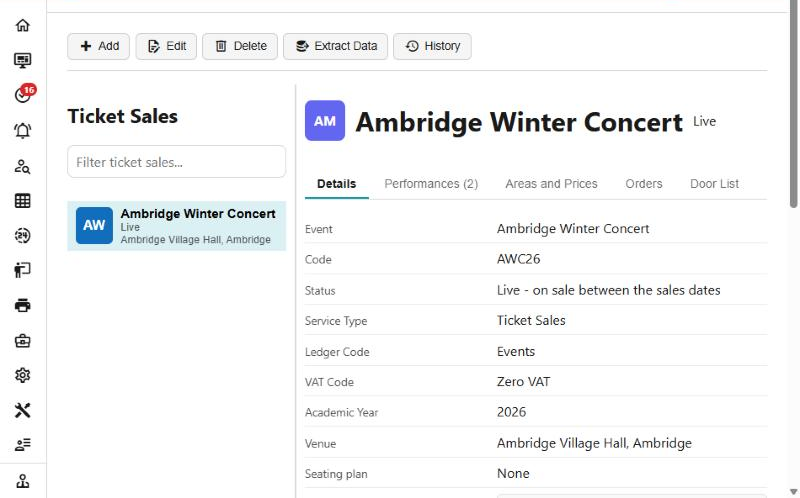
The Details tab carries the event itself: its name, description, picture, instructions and terms, where it is, when tickets are on sale, who may buy, and how long a basket is held.
A few of these are required before it will save, and Xperios says which:
- a service type whose category is Ticket Sales
- a ledger code the sales post to, and a VAT code
- an academic year the sales are invoiced in
- sales close after they open
- tickets held for between 5 and 60 minutes
- a link code — press New link if there is not one
- a seating plan, if buyers are to choose their own seats
Status runs Pending while you set it up, Live while it is on sale between the sales dates, then Cancelled or Finished. Nothing is on sale until it is Live — and being Live is not enough on its own, because the sales window still applies.
Who can buy, and how they get there
Every event has a sales link with an unguessable code in it, and Audience decides how widely it is known:
| Audience | What it means |
|---|---|
| Only people with the link | Not listed anywhere. The link is the only way in |
| Portal and app users — listed for them | Your own families see it when they sign in |
| Anyone — also listed on the public page | Listed publicly, as well as reachable by its link |
Copy link puts the address on your clipboard for a newsletter or a website. Send sales link emails it to an audience you choose. Either way the page opens before anybody signs in, so a buyer can see the show and the prices first and sign in when they are ready to pay.
Performances
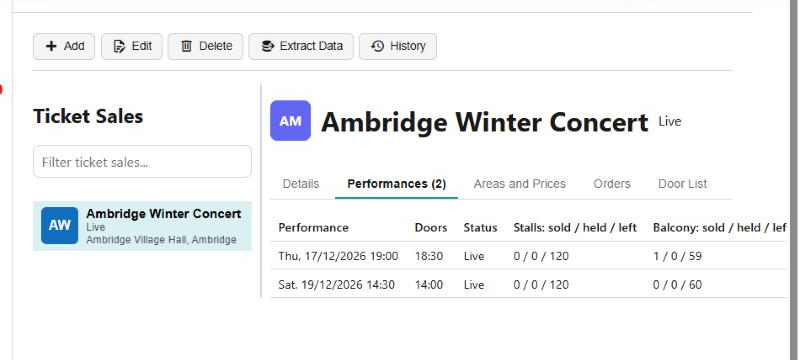
Each performance has its date and time, when the doors open, its own sales close if you want one, and a status of its own — Live, Sales stopped or Cancelled. Stopping sales on one night leaves the others selling.
Beside each is a count per area: sold / held / left. Held means a basket is open on those seats and has not been paid for yet, so the middle number moves on its own and settles again when baskets expire.
A performance must end after it starts, and its sales cannot close after it has started.
Areas, prices and bundles
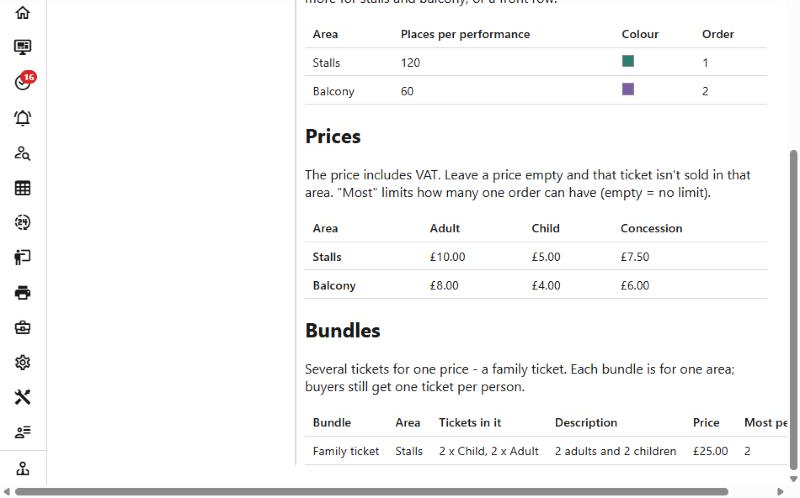
Areas are the parts of the house you price differently. Most events need only one; add more for stalls and balcony, or for a front row. Each carries the number of places per performance, a colour, and the order they are shown in. Every area needs a name, and two areas cannot share one.
Prices are a grid: your areas down the side, your ticket types across the top, a price in each cell. Two things are worth knowing about it:
- the price includes VAT
- leaving a cell empty means that ticket is not sold in that area — it is how you say "no concessions in the balcony" rather than something being unfinished
Most beside a price limits how many of it one order may have; empty means no limit.
Bundles are several tickets for one price — a family ticket of two adults and two children. A bundle belongs to one area, and the buyer still gets one ticket per person, so the door list and the admissions are unaffected.
Seated events
Where you want buyers to choose their own seats, give the event a seating plan and a Seating tab appears. The plan is drawn once for a venue room and reused by every event in it, so a hall is laid out once rather than per concert.
On the event you paint the plan's seats into your areas, which is what connects a seat to a price. Per performance you can block seats — for a sound desk, or a reserved row — and see who is holding one.
Without a plan an event is simply areas with a number of places each, which is all most concerts need.
Buying, and what holds a seat
Buying follows the pattern every ticketing system uses: hold, pay, issue.
- The buyer picks a performance, then either how many of each ticket they want in each area, or their seats on the plan.
- The seats are held — for the number of minutes the event allows — and the order is priced on the server. Nothing is admissible yet.
- They pay by card. Paying extends the hold once, so nobody is cut off part-way through the card provider's page.
- The payment confirms: the order is paid, the seats are sold, the invoice and receipt are raised, and the emails go.
A basket nobody pays for gives its seats back on its own when the hold runs out. That is why the held count on the Performances tab goes up and down without anybody doing anything, and why seats are not lost when somebody abandons a purchase.
Where every price is zero the payment steps are skipped — the order is confirmed at once and no invoice is raised.
The buyer becomes a debtor
Buyers sign in with their Paritor Identity, which makes them a contact, and paying makes them a debtor if they were not one already. The invoice and the door list are therefore in the buyer's name.
Orders
The Orders tab lists every order on the event: its number, the buyer, the performance, how many tickets, the total and the status.
| Status | What it means |
|---|---|
| Awaiting payment | Held, not yet paid |
| Paid | Confirmed, tickets issued |
| Expired | The hold ran out and the seats went back |
| Cancelled | Cancelled by your office |
| Refunded | Cancelled and the money returned |
Open an order to see its tickets, its invoice and its payment, and to cancel or refund it, resend the tickets, or add a note.
Cancelling an order cancels its tickets and frees its seats. Where it was paid, a credit note is raised against the invoice and the money refunded through the card provider where that is supported, or marked for you to refund by hand. The buyer is emailed either way.
Cancelling a performance does the same to every order on it, and emails each buyer once. Moving a performance — a new time or a new room — emails the holders and leaves their tickets valid.
Buyers cannot cancel their own tickets, which is the usual arrangement for ticketed events. Say so in the event's terms.
The door list
The Door List tab gives you the night's list by buyer surname: the order number, how many tickets of each type, the seats where there are seats, any notes, and a box to tick as people arrive. It prints, and it exports.
There is also a Master query and report, Ticket Sales - Door List, if you want the same list laid out your own way.
What gets emailed
Ticket Sales has its own set of message templates, overridable per service type like every other kind:
| Sent | |
|---|---|
| Sales open | When you press Send sales link |
| Purchase confirmation | When an order is paid |
| Here are your tickets | With the confirmation, or a set number of days before the performance |
| Order cancelled | When your office cancels an order |
| Performance changed | When a performance is cancelled or moved |
| Performance reminder | A set number of days before, if you ask for one |
The tickets email carries a PDF, one page per ticket, with the performance, area, seat, type, order number and a code for the door.
The two settings lists behind it
Ticket Types (Settings > Finance) are the kinds of ticket every event prices — Adult, Child, Concession, Senior. They are shared by every event, so add the ones your service uses once and they appear across the top of each event's price grid.
Seating Plans (Settings > Finance) are halls, drawn once. A plan belongs to a venue room and holds its sections, rows and seats, so an event that lets buyers choose seats sells from a plan rather than from a bare number of places.
See also
- Events — the other kind of event, the one people apply for
- Finance settings — Ticket Types and Seating Plans, with the rest of the money lists
- Debtors — where a buyer's invoice and payment end up